
No products in the cart.: 0 $


Why “One Wallet Per Chain” Is Dead: Mechanisms and Trade-offs Behind Rabby’s Multi‑Chain Approach
A common misconception among experienced DeFi users is that a wallet’s job is simply to store private keys and sign transactions. In practice, a wallet is an active safety layer, a UX amplifier, and often the difference between a harmless mistake and a catastrophic loss. That matters particularly for power users who hop between Ethereum mainnet, rollups, and competing EVM chains. This article explains how a purpose-built multi‑chain wallet with transaction simulation changes the risk profile of active DeFi use, what it cannot do for you, and how to decide whether to install the extension or keep a mixed setup of hardware + multiple wallets.
I’ll focus on the mechanisms that deliver security and convenience—transaction simulation, pre‑transaction risk scanning, automatic network switching, approval revocation, and hardware wallet integration—how they interact, and where they leave residual exposure. Throughout, I’ll translate those mechanisms into practical heuristics DeFi users can apply right away when evaluating a wallet like rabby for US‑based usage and institutional contexts.
Mechanism 1 — Transaction Simulation: what it is and why it matters
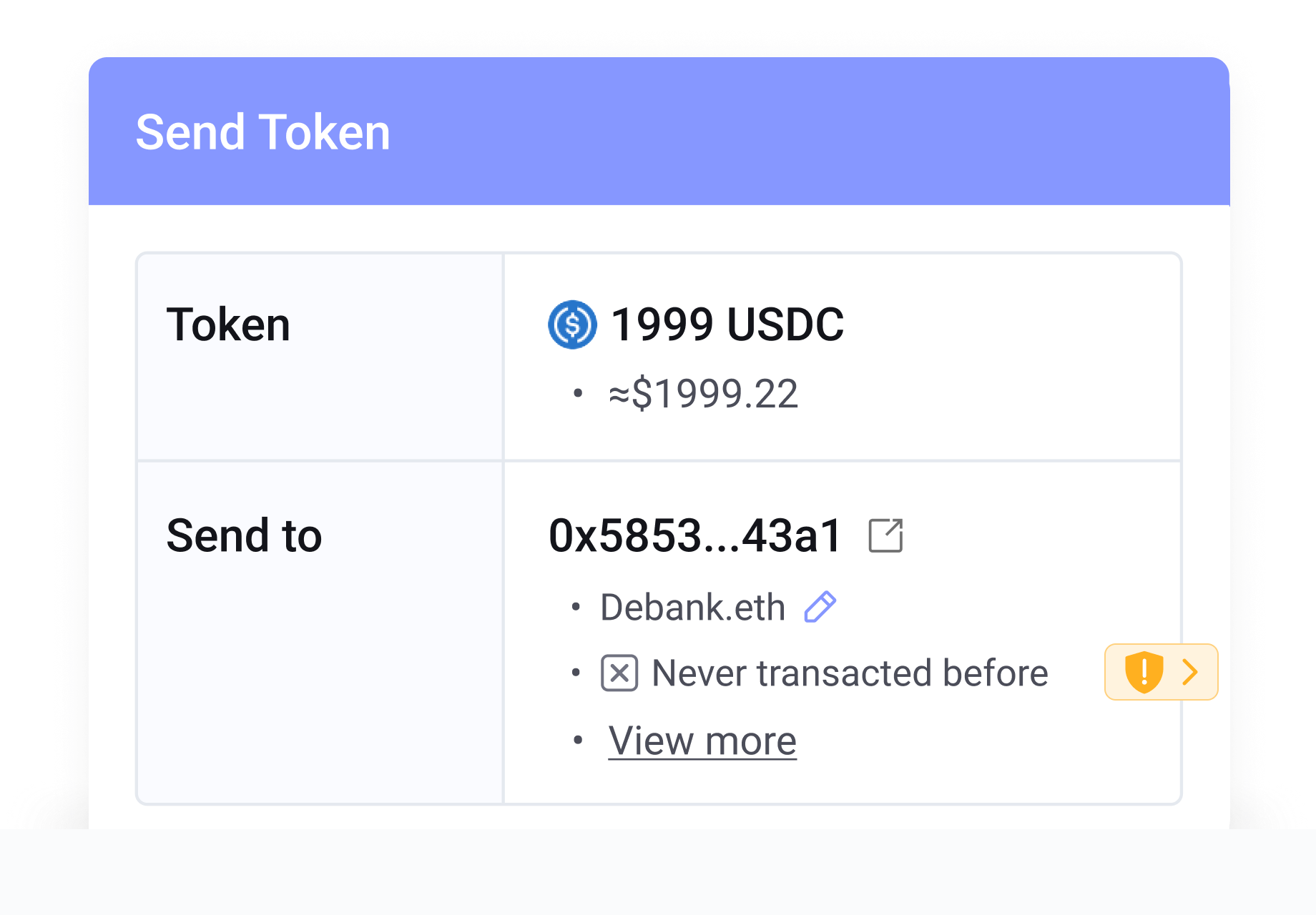
At its core, transaction simulation runs the exact transaction call locally or on a node before you sign and broadcasts the simulated state changes: token deltas, ERC‑20 approvals, and estimated gas. This is different from transaction previews that simply show the ABI‑decoded function and raw numbers; simulation produces a map of “what will change in my balances and allowances” if the chain accepts the transaction. For active DeFi traders, that is a material reduction in blind‑signing risk.
Why it helps: many attacks exploit user inattention to approvals or unexpected contract behavior (reentrancy-style manipulations, or functions that sweep tokens). Simulation exposes those outcomes before you commit. The trade-off is latency and possible divergence: simulations depend on up‑to‑date on‑chain state and node responses. If a mempool front‑run, pending oracle update, or race condition exists between simulation and actual broadcast, the simulation might not reflect the final executed outcome. So simulation reduces, but does not eliminate, execution risk.
Mechanism 2 — Pre‑Transaction Risk Scanning and Approval Management
Pre‑transaction risk scanning annotates transactions with contextual threat signals: whether a contract has a history of hacks, whether an approval request is unusually permissive, or whether the destination address is recognized as non‑existent or suspicious. When combined with an approval revocation UI, a wallet becomes an active guardrail: it can flag dangerous approvals and enable immediate revocation of existing allowances to limit exposure.
Mechanically, this uses on‑chain heuristics plus off‑chain reputation data. That introduces a dependency: the scanner’s coverage and accuracy depend on the threat database and the heuristics’ false‑positive/false‑negative profile. Users must accept that no scanner sees everything—novel exploits or well‑disguised malicious contracts can slip through. The practical heuristic: treat scanner alerts as high‑quality signals, not absolute proof. If a critical alert appears, pause and investigate, but don’t assume every green result equals safety.
Automatic Network Switching, Multi‑Chain Support, and Cross‑Chain Gas
Power users who interact with dApps across 90+ EVM chains face a repetitive source of error: manual network switching. Automatic network switching reduces UX friction and the risk of sending transactions to the wrong chain (or signing a transaction that the active wallet account can’t fund). Mechanically, the extension detects the dApp’s target chain and switches the provider network in the extension—this is a convenience plus a safety net.
Cross‑chain gas top‑up is an operational accelerator: if you need a small amount of ETH on a rollup but only hold tokens on mainnet, the wallet can top up gas across networks without a separate bridging workflow. That decreases friction but again increases attack surface if the bridge or cross‑chain mechanism is compromised. The trade‑off here is clear: fewer manual steps and lower operational friction versus a need to trust the wallet’s cross‑chain primitives and their security practices.
Hardware Wallet Compatibility, Multi‑Sig, and Institutional Usage
Non‑custodial wallets that integrate hardware devices (Ledger, Trezor, Keystone, and others) and multi‑signature systems (Gnosis Safe, enterprise custody like Fireblocks) combine the convenience of a modern extension with the custody guarantees users expect. Mechanically, the extension acts as an interface: it prepares transactions, runs simulations and scans, then delegates signing to an attached hardware key or multi‑sig flow.
This separation materially lowers private key exposure, but users must still manage physical device security, firmware updates, and multi‑sig governance rules. Institutions gain operability, but they accept complexity: onboarding, signer policies, and recovery procedures must be defined and tested. For US institutions concerned with compliance and operational resilience, using hardware + multi‑sig is usually superior to single‑signature software‑only approaches—if the governance is properly engineered.
Open Source, Past Incidents, and the Limits of Audits
Open‑source MIT licensing allows independent audits and community scrutiny. That transparency is valuable because it lets third parties review the code pathways that implement simulation, scanning, and cross‑chain features. However, open source is not a guarantee of safety; it is an enabling condition for meaningful security assessment. The 2022 Rabby Swap contract exploit that resulted in ~$190k losses illustrates this boundary: the team froze the contract, compensated users, and increased audits. That sequence is instructive: incident response and remediation matter as much as the absence of prior incidents.
Security audits reduce certain classes of risk—implementation bugs, flawed cryptography assumptions—but cannot eliminate economic or social engineering attacks (phishing dApps, compromised developer websites, malicious browser extensions). Practical rule: prefer wallets that combine open source, audited code, responsible disclosure processes, and a public incident history with clear remediation steps. If a vendor lacks transparency about incidents, treat that as a signal to require additional controls (hardware-only signing for high-value operations, smaller per‑transaction approvals, and regular allowance revocation).
Where Rabby’s Design Helps—and Where It Doesn’t
Rabby packages several mechanisms that matter to active DeFi users: simulation to avoid blind signing, pre‑transaction scanning to flag suspicious transactions, automatic chain switching to reduce human error, and a built‑in revocation tool to limit approval risk. Those features are particularly useful for users managing many small positions across chains and trading on DEXs or interacting with complex composable strategies.
But two material limitations remain: there is no built‑in fiat on‑ramp (you’ll still need an external exchange or on‑ramp provider to buy crypto with fiat), and the wallet does not provide native in‑wallet staking. Those omissions affect some workflows directly: if you want an all‑in-one onboarding experience for a nontechnical user in the US, Rabby will need to be paired with an exchange. Similarly, institutional staking workflows often use custodial or validator‑specific tooling that the wallet does not replace.
Decision Framework: Should a Power User Install the Extension?
Here are practical heuristics you can apply. They are deliberately short so you can use them as a checklist:
1) Value of active simulation: If you perform many contract interactions per day (arbitrage, LP management, position rebalancing), transaction simulation materially reduces execution risk—install. 2) Hardware-first security: If you hold significant assets, attach a hardware wallet and use the extension as an interface; don’t rely on the extension alone. 3) Approval hygiene: If you frequently approve new contracts, use the revocation tool and set allowances to minimal necessary amounts. 4) Cross‑chain workflows: If you move assets frequently across rollups and chains, the automatic network switching and gas top‑up features improve operational efficiency. 5) Institutional controls: If the use case demands compliance or multi‑signature governance, verify integrations (Gnosis Safe, Fireblocks) and test recovery procedures before production use.
These rules reflect trade‑offs: convenience versus custody guarantees, speed versus potential simulation divergence, and broader integration versus increased attack surface. No single wallet removes every risk; they reallocate and reduce certain classes of vulnerabilities while leaving others to governance and operational practice.
What to Watch Next
From a signals standpoint, the next meaningful indicators to monitor are: expanded integrations with regulated custody providers (which would improve institutional adoption in the US), improvements in simulation fidelity to reduce divergence with live execution, and any further centralized service dependencies introduced by cross‑chain features. Each of these changes would shift the trade‑off calculus for institutional users and power traders. Conversely, any repeat high‑impact incident or opaque remediation would justify temporary hardening (move funds to hardware/multi‑sig, pause automated approvals) until the root causes are public and fixed.
FAQ
Does transaction simulation make blind signing impossible?
No. Simulation significantly reduces blind‑signing risk by showing expected balance and allowance changes before you sign, but it cannot guarantee outcomes in the presence of mempool reordering, front‑running, or rapidly changing on‑chain state. Treat simulation as a strong safety layer, not an absolute safeguard.
Can I use Rabby with a hardware wallet and Gnosis Safe?
Yes. The extension supports a wide set of hardware devices and integrates with institutional multi‑sig solutions like Gnosis Safe and enterprise services. Use the extension as the UX layer and perform final signing through your hardware device or multi‑sig policy to maintain custody guarantees.
Is there a fiat on‑ramp inside the wallet?
No. A known limitation is the absence of a native fiat on‑ramp—users in the US must acquire crypto through exchanges or third‑party on‑ramp providers and then manage transfers into the wallet.
What should institutional users test before moving funds?
Test multi‑sig workflows end‑to‑end, verify hardware wallet firmware and compatibility, execute simulated transactions and revocation flows, and rehearse incident response (how to freeze or replace keys). Confirm custody and compliance requirements are met before live deployment.
Final takeaway: modern DeFi wallets are more than key stores; they are active decision engines. For active users and institutions operating across many EVM chains, a wallet that simulates transactions, scans risks, and integrates with hardware and multi‑sig systems meaningfully lowers certain operational risks—but it does not eliminate human error or systemic crypto risks. Pair these tools with disciplined custody practices, least‑privilege approvals, and testable governance to convert technological capabilities into safer outcomes.